How duck 'soldiers' became this 300-year-old winemaker's secret weapon
.png)
How duck 'soldiers' became this 300-year-old winemaker's secret weapon
Almost every wine-producing country in the world experiences difficulties with the local wildlife, from deer (who are apparently a proper pain when it comes to nibbling the fresh grapevine shoots) and boar in Europe, to more exotic beasts in other parts. However, in some countries, animals are playing a key role in protecting vineyards, and the balance between winemaker and wildlife is far more beneficial. We’ve recently been reading about llamas in Chile being used to eat weeds, armadillos in Patagonia being welcomed in the vineyard for eating small pests, and bobcats in California being encouraged for scaring away deer and rabbits.
***************************
Since the 1980s, hundreds of ducks have patrolled the Wine Estate outside Cape Town, South Africa. It's a centuries-old practice that helps keep the vineyard free of pests. Look through the gallery to learn more about the army of ducks protecting vines, and other animals with jobs that might surprise you.
The Wine Estate in South Africa, about a thousand Indian runner ducks parade twice a day into a vineyard to rid it of pests. It's a remarkably orderly scene.
Unlike your typical waddling duck, these ducks don't sway back and forth. They run quickly in a straight line.
Every morning at 9:45 a.m., they emerge from a gate and zip around the gleaming white manor house – even sticking to a manicured gravel path. They run in formation. Their beaks all point in the same direction, their bodies all turn at the same time — like they've worked on the choreography beforehand.
The previous owner of the wine estate, John, is a bird lover and brought them over from Asia. They have been at the estate for at least 30 years.****************************

South Africa's wine industry employs around 270,000 people, producing some of the world's most sought-after wines. But not all jobs are best left to humans. In some cases, it's better to get your ducks in a row -- and then put them to work.
Outside Cape Town on the banks of the river, the Wine Estate has repurposed a centuries-old practice by marshaling a battalion of ducks to keep its vineyard free of pests.
Inspired by ducks used to remove pests from rice paddies in Asia, the winery calls on the services of some 1,600 ducks as part of its effort to make wine production more sustainable.
I call our ducks the soldiers of our vineyards, says the managing director.
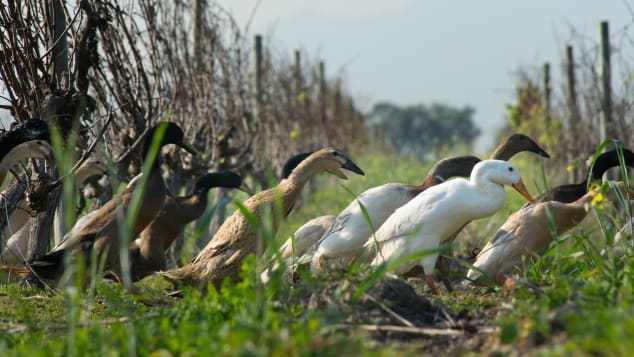
They will eat aphids, they will eat snails, they will eat small worms -- they keep (it) completely pest-free.***********************
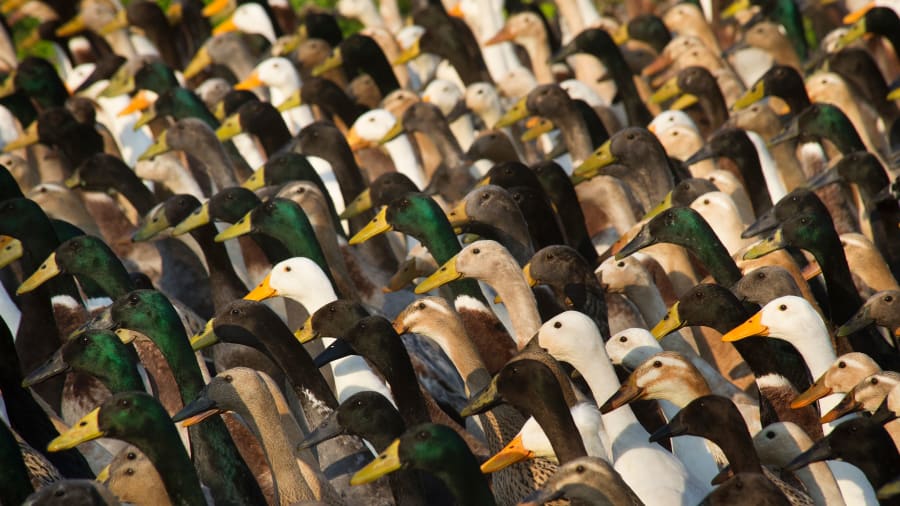
The species, the Indian runner duck, is flightless, with a peculiarly upright stance and highly developed sense of smell. The duck troops are cajoled on a 14-day circuit through the vineyard, eating and fertilizing the ground as they go.
The ducks' "annual leave" takes place during the harvest (they'd eat the grapes). During this time they forage on open farm pasture, swim in a nearby lake and undergo selective breeding.
Duck eggs are consumed in the vineyard restaurant, but never the ducks themselves -- "that would be like eating a colleague," Gavin, the estate's tasting room manager, said in an interview.

"The world is moving away from more conventional farming to (being) a bit more organic," he explains. "For him, it's a big goal ... to have less influence on the Earth, the soil and the environment." Other sustainable initiatives include an extensive solar power plant and a 25-hectare wetland conservation area on the farm.
The ingenious pest control system has been deployed since the 1980s, but the fowl-based feeding frenzy could soon be spreading its wings.**************************
As a pioneering winemaker with industry clout -- vines have being grown on the estate since the late 17th century -- he is hoping to convince others to adopt its approach. Visser says the vineyard plans to sell 750 ducks to other vineyards and replenish numbers by breeding the birds. "We can be in a position where we say that we have (not just) the best runner ducks in South Africa, but also the world," Visser argues.

"I think the industry itself has the potential to engage more in experimental ways," he adds. That requires money, and increasing the price point of South African wines in the world market could help fund and other vineyards' green initiatives.
If we can achieve that, we can then put back some of that (income) into our people, into our land, and become more sustainable.
They'd be quackers not to.*******************************
Winemaking Risks: Raise a Glass to our Brave Vintners.
Well, there you have it - a brief rundown of the risks and problems our brave and hardworking winemakers face every year, and all so you and I are able to neck a bottle of red of white on a lazy afternoon or evening in. If that doesn’t make you grateful for their amazing dedication and commitment, then nothing else will. Cheers.


Comments
Post a Comment