(New 2026) How extinct animals could be brought back from the dead

Millions of years ago, thylacines, also known as Tasmanian tigers, were widespread across Australia. About the size of an American coyote, these dog-like creatures with stripes disappeared from the mainland around 2,000 years ago. They remained in Tasmania until the 1920s, when they were slaughtered by European colonizers who saw them as a threat to livestock.
"It was a human-driven extinction – European settlers came to Australia and brutally obliterated this animal," a geneticist at the University of Melbourne.
-----------------------------*****************************------------------------------
He is leading a team of scientists who, aim to recreate the wolf-like creature and bring it back.
Thanks to recent advances in genetics, namely the advent of gene editing technology Crispr-Cas9, it is not the only lost species that we could soon see again. How does the science work, and what kinds of ethical questions does it raise?
In the case, the first step is sequencing the extinct animal's DNA – the genetic blueprint contained in every single cell of the body.
The great thing is that as it was such an important marsupial every major museum wanted one in their collection, so there are hundreds of samples around the globe, and some are exceptionally preserved.
-----------------------------*****************************------------------------------
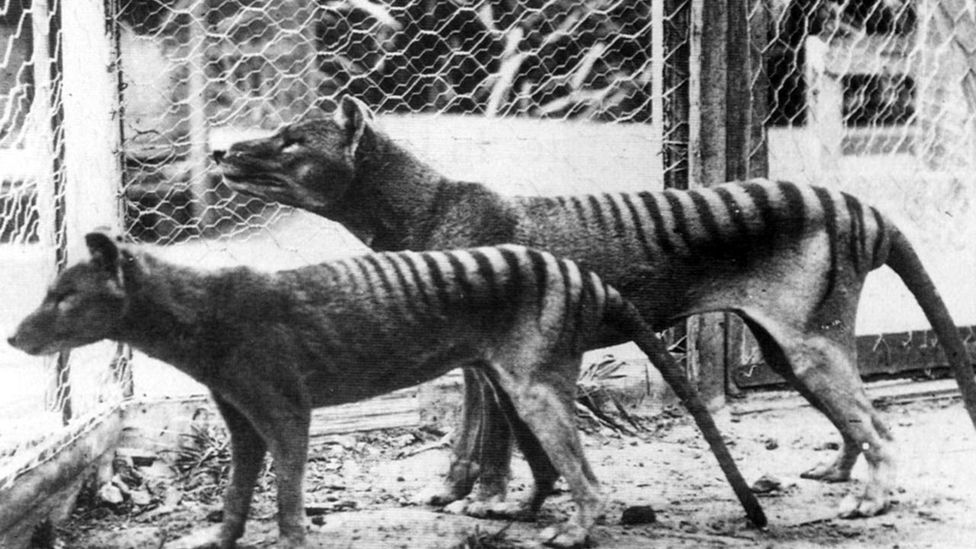
"Our sample was a baby taken from its mothers' pouch. They shot the mum and immediately dropped the baby into alcohol, which preserves DNA. That was the miracle specimen and the holy grail for us in terms of being able to really build that genome."
-----------------------------*****************************------------------------------
Although it's in pretty good condition, the DNA isn't completely whole. Over time, exposure to UV light and the action of bacteria break down DNA into short fragments. The older the sample, the smaller the fragments that are left behind, until eventually there isn't enough left (there's no chance of bringing back a dinosaur, for this reason).
This leaves scientists with the seemingly impossible task of working out how the various bits of DNA fit together – a task comparable to completing an enormous jigsaw without the helpful picture on the front of the box.
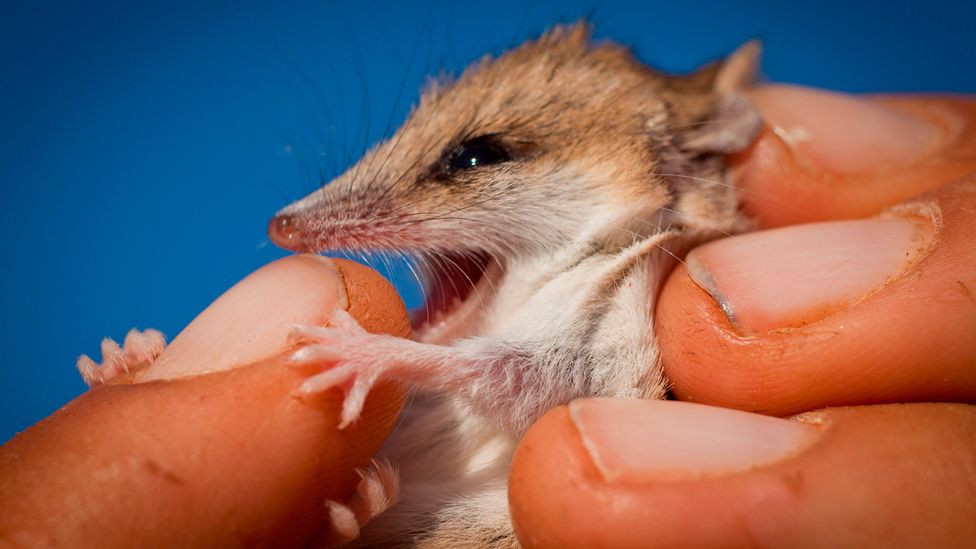
Luckily, a small mouse-sized marsupial was able to provide a blueprint.
We found the closest living relative.
-----------------------------*****************************------------------------------
We sequenced the genome and compared that genetic code to our extinct species, we then overlapped them and found everywhere where it was different.
However, knowing an animal's DNA is simply not enough to bring it back. The next stage of the puzzle involves tweaking the genes so that they match. This can be done with Crispr-Cas9, the Nobel Prize-winning genome editing method.
We start with living cells, and we begin to edit all of those changes, so we essentially engineer or turn that cell into a living.
Previously, gene editing wasn't advanced enough to be able to change all the differing sequences to DNA in one go. With millions of edits needed, it was assumed that researchers would need to prioritize the most important DNA sequences, yielding an animal genome that wasn't exactly the same as the extinct one.
-----------------------------*****************************------------------------------
"All of those technologies are in place, but nobody's done it on this scale before because the DNA-editing technology wasn't good enough or quick enough. But now it's come such a long way that we do have that tech, and we have had significant investment to try and make this work."
Once the researchers have a cell, they still need to turn it into a developing embryo, and then implant it into a living close-relative's womb. If that sounds easy, then it isn't. We have a lot of work to do.
"We've already made marsupial stem cells, which took us about five years. We're now putting those stem cells into embryos to see if we can get them to develop into a whole living animal."
-----------------------------*****************************------------------------------
It isn't just that could be brought back this way. Preserved scraps of woolly mammoth DNA found frozen in Arctic tundra mean that this large mammal could return. Most woolly mammoths died out roughly 10,000 years ago.
Scientists at Colossal Laboratories and Bioscience – cofounded by researchers from Harvard University – are using to splice bits of mammoth DNA into the genome of the Asian elephant, the mammoth's closest living relative. The resulting hybrid, would be adapted to the cold Siberian tundra, and could help fill an ecological void left by the mammoth when they went extinct.
There are, however, limitations with the technology, and obstacles that still need to be overcome.
"Many attributes that we have as living animals require several different copies of genes, but it's not easy to tell from looking at a reconstructed genome how many are needed," says Michael Archer, a paleontologist at the University of New South Wales in Sydney, Australia.
-----------------------------*****************************------------------------------
However, genome reconstruction is not the only method scientists could use to resurrect extinct animals.
The aurochs, a type of prehistoric cow, is the subject of ancient cave paintings around the globe. It once roamed the plains of Europe and stood as tall as an elephant. It became extinct in the 1600s. Although long gone, aurochs genes can still be found in various breeds of cattle around the continent, with descendants in Spain, Portugal, Italy and the Balkans. Geneticists are now "back breeding" these species together to produce offspring closer to the qualities of an aurochs.
Another idea is to essentially clone the dead animal by taking the nucleus from an intact cell, and then transferring it into the egg of a close living relative in the hope that an embryo will form.
-----------------------------*****************************------------------------------
The caveat is that you need a complete cell to do this, and cells quickly break down after death. An animal like that died out almost a hundred years ago simply couldn't be brought back this way.
But it could be an option for recently extinct species.
In 2003, researchers successfully cloned a Pyrenean ibex, a type of goat that went extinct when the last living individual was killed by a falling tree. Sadly, the newborn died of a lung defect shortly after birth.
Archer is currently using a variation of cloning technology to bring back the southern gastric-brooding frog, a species native to Queensland, which became extinct in 1983. The creature had a bizarre method of reproduction, swallowing its fertilized eggs and using its stomach as a sort of womb.
In 2013, he completed the first step – transferring the nucleus from a frozen frog cell into the empty egg of a closely related amphibian. Incredibly, the cells started dividing, and an embryo was formed.
"We did it many hundreds of times, and it didn't work, and then suddenly one of them did, and we saw this hybrid embryo start to divide under the microscope, and it was very exciting," says Archer.
After this initial excitement, however, the project stumbled when none of the embryos developed into tadpoles or frogs.
-----------------------------*****************************------------------------------
"The frog embryos developed into a ball of cells, which is normal embryonic development, but then they stopped," says Archer.
"Normally the outside layer of cells folds in and you get a two-layered structure which leads to a tadpole, but ours didn't do that."
The same thing happened when the team tried to create an embryo with two living species of frogs, suggesting that it was an aspect of their experimental work that was interfering with the development of the embryo, rather than a problem with the extinct frog's DNA.
"We're working to find out what this obstacle is in living frogs before we can go back to the extinct animal's DNA," says Archer.
-----------------------------*****************************------------------------------
Even if we can bring back extinct animals, there are ethical considerations.
Reintroducing mammoths might upset existing ecosystems. Since these animals became extinct, others will have evolved and adapted to fill their place. Will these organisms suffer as a result?
Thanks to climate change, the environments these creatures once lived in may have changed drastically. Some of the plants woolly mammoths fed on are long gone as well. Would mammoths still be able to survive on their own in the wild, and if not, who would look after them? Would they just end up as curiosities in a zoo?
"I don't think we should bring all animals back. I think it should have to fit certain criteria," says Pask.
"For it's a recent extinction event, so its habitat in Tasmania still exists, all the food it used to eat still exists, so there's somewhere for them to go and they can thrive again in that environment.
"This animal also played a critical role in the ecosystem. It was an apex predator so it sat right at the top of the food chain. There are no other marsupial apex predators so when it was made extinct it left a massive gap."
-----------------------------*****************************------------------------------
Some researchers argue that efforts to bring back long-gone species could detract from conservation efforts to save existing animals and even increase the risk of biodiversity loss, and that people may be less incentivised to stop eating meat and destroying habitats.
But de-extinction technology could be used to save living species on the brink of extinction, especially those with an extremely small gene pool, like the white rhino.
Black headed ferrets are one of North America's most endangered animals – every ferret alive today can trace its ancestry to just seven individuals. Yet researchers at Santiago Zoo in Chile recently took frozen cells from a black footed ferret which died 30 years ago, and used them to create a clone, Elizabeth Ann. Elizabeth's DNA is entirely different, so she can bring a welcome boost of genetic diversity into the population.
"De-extinction tech isn't just about bringing back, it's about preventing other animals from becoming extinct," says Pask.
-----------------------------*****************************------------------------------
"We have so many bush fires in Australia, and with rising global temperatures we are going to see more adverse weather events in the decades to come. What Australia has been doing is collecting tissues from marsupials in those areas that are most at risk and freezing them. This means that if a bush fire came along, once the vegetation grew back you could repopulate that area with that species."
Archer agrees that the moral rights outweigh any wrongs.
"I think it would be unethical not to do it. I think the ethical issue here was the impropriety of humans making these animals extinct in the first place. It's not about playing God, this is about playing smart human by undoing what we did."
-----------------------------*****************************------------------------------


Comments
Post a Comment